Wednesday, May 16, 2018

Auld Lang Syne


Robert Burnes

Robert Burnes, the writer of the Scots poem “Auld Lang Syne”, is born on 25 January 1759 and died on 21 July 1796. This Scottish poet and lyricist is seen in Scotland as a national poet. He is the best known of all for his poems in Scots language. He also wrote in a light Scots dialect but much of his writings were in English.


The history of the song


Auld Lang Syne was written in 1788 by Burnes but in fact he didn’t invent the whole song. He’s the first known person who wrote down an older Scottish folk song and he sent his version to the Scots Musical Museum with the remark: "The following song, an old song, of the olden times, and which has never been in print, nor even in manuscript until I took it down from an old man’’.

 Auld Lang Syne means in fact "old long since" or "long long time". It could be dated back to the 15th century and was used in the 16th and 17th century too. After that it has been printed in 1711 by James Watson.


Melody

The song has a Scots folk melody and this melody is similar to the overture of William Shield’s opera Rosina. Maybe was the poet inspired by it? This melody is also similar to this of ‘God Save the Queen’.

Lyrics

The song begins with a rhetorical question. ‘Is it right that old times be forgotten?’ The answer to this is the most of the time interpreted as a call to remember friendships that are lasting since a while.


Uses

  • "Auld Lang Syne" is first of all sung at New Year Eve. In Scotland it’s the tradition to dance: they join their hands with the people next to them and form a circle. At the end of the song, everyone heads to the centre. People are enjoying the moment and are taking pleasure in doing it.The song is there at New Year also to keep friendships in heads. But also to remember the good deeds and wills they had or made in the past year: it’s a toast for all the accomplished things.
  • In the Maldives and Korea, the tune has been used for their national anthem. It’s also used for hymns in sporting clubs and in memorials of Robert Burnes.In Japanese department stores, they play the song at closing time to remind their costumer politely to exit.
    All over the world this song is the soundtrack in memorable film scenes like sex and the city, it’s a wonderful life, forest gump and many others
  • The song is sometimes used at funerals and graduations. They remember old friends as time marches on.

Big representations

The song has been recorded in other languages, in other styles by other singers. We can find for example, Guy Lombardo and His Royal Canadians who popularised the song in the States. But next to it, we have the French translation we all know, ‘’ce n’est qu’un au revoir’’. There are also many covers: Jimi Hendrix (1970), The Beach Boys (1983), Aretha Franklin & Billy Preston (1987), Barbra Streisand (2000), Mariah Carey (2010),... Finally, it has been ‘nationalised’ in the East thanks to Korea, Japan, India, China and other East Asian countries. 

Here's a modern version of the tenors written in their album (Christmas Together) in 2017:


Conclusion


‘Auld lang syne’ is a song that influences music and that appeared in films since a while. It touch a lot of people all over the world thanks to the lyrics and gives lots of memories.
This song is an icon of the Anglophone culture because It’s an old Scottish and historical song but also tradition. After a short among of time it became a global phenomenon and is now also used to be song in each English cultures on New Year Eve.


The life of Bear Grylls


Edward Micheal Grylls, better known as Bear Grylls, is an explorer, adventurer and traveler who is best known for his reality show Man vs. Wild.
Bear Grylls was born on the 7 June 1974 in Donaghadee, in Northern Ireland.

From 1994 to 1997 he was in the British Special Air Service as a soldier.


In 1996, he survived a freefall parachuting accident in Zambia. His parachute tore at 4 900 meters, causing him to fall and land on his parachute pack on his back, which hurt three of his vertebrae. After this, he had a few months of reeducation and was able to walking again.

The accident made him realize that he wanted his childhood dream, which was to climb the Everest, to be accomplished. Therefore, in 1997, he became the youngest British alpinist to climb Mount Everest and in 1998 he entered the Guinness Book at the age of 23. 

Since 2000, he has been married to Shara Cannings with whom he has got three sons.
In 2002, he graduated from Hispanic studies field. He can speak English, which is his mother tongue, as well as French and Spanish fluently.


In 2000, he raised money for the Royal National Lifeboat Institution by leading the team to navigate around the British Isles on jet skis. This took more or less 30 days.
He also led a team to travel in a rigid inflatable boat to cross the North Atlantic Ocean, facing terrible gales and heavy waves during their journey form Halifax, Canada, to John o’ Groats, in Scotland.


After these different challenges, Bear Grylls decided to start a TV show entitled "Survivor” for the British, and known in France as "Seul face à la nature" and in the rest of Europe as “Ultimate Survival”. In the United States, the program is better known as Man VS Wild. It was first broadcasted in 2006 and its success led to three extra seasons over the next two years.


The aim of the producers is to show viewers how to survive in hostile places with little material. 
In 2008, they climbed one of the greatest peaks in the world in Antarctica, to raise funds for children’s charity “Global Angels” and further the progress of the use of alternative energies.
In 2014, a new series appeared in the United States called “Star VS. Wild” including several famous guests such as Channing Tatum in the first season, Barack Obama in the second season and Julia Roberts in the third season. The main goal is similar to the previous show. “Star vs Wilds” is based on the survivalist concept too, but with a celebrity accompanying Bear Grylls for the journey, which included skydiving into the Catskill Mountains and climbing the cliffs in the State of Utah.


Moreover, Bear Grylls has written some books describing his achievements and expeditions to famous places like Mount Everest. Facing up came out in 2012, for example. 


And he released his autobiography, Mud, Sweat and Tears: The Autobiography.

Sources:
https://www.thefamouspeople.com/profiles/bear-grylls-6100.php
https://short-biography.com/bear-grylls.htm
https://fr.wikipedia.org/wiki/Bear_Grylls
https://starsunfolded.com/bear-grylls/
https://mpora.com/camping/bear-grylls-biography-everything-need-know
https://en.wikipedia.org/wiki/Running_Wild_with_Bear_Grylls
https://www.nbc.com/running-wild-with-bear-grylls?nbc=1

TV Show:
“Man vs Wild”
“Star vs Wild”

Videos:
https://www.youtube.com/watch?v=oa6N7agxizw

Pictures:
From google image

Tuesday, May 15, 2018

Butlin's Holiday Camps


Butlin's Holiday Camps


Butlin’s camp is a chain of large holiday camps in the United Kingdom which was founded on January 1 1936 in Ingoldmells, situated near Skegness on the east coast of England. Since 2017, this camp is protected and listed as Grade II. It joins, such as 1040 others monuments this same year, the list of protected monuments created by Historic England. The monuments placed on this list cannot see their structures being modified in any way without a special permission from the local authority.  

The founder:

In the first part of its existence, the company belonged to Billy
Billy Butlin
Butlin, the founder. Billy Butlin is a British, Southern-African entrepreneur. He was born in 1899 in Cape town in South Africa. He had a hard and terrible childhood partly because of the separation of his parents when he was only seven. After the separation, he travelled with his mother to England where he lived for the next five years. At the age of twelve his mother left him to the guard of his aunt because she had to emigrate to Canada. After this event, Mr Butlin had none of his real parents close to him.
Rank Organisation

Billy Butlin took his retreat in 1968 and died in 1980. When he took
his retreat, his son, Bobby Butlin took over the company and remained the head of this one until 1984. Bobby had to sell the company to the Rank Organisation in 1972 because of some economic problems. The British sea-side became deserted from the tourists and so the company earned way less money than before. Bobby Butlin still remained head of this one until his retirement and then the company got in full hands of the Rank Organisation 

 In the first part of its life, the company belonged to Billy Butlin, the founder. Billy Butlin is a British, Southern-African entrepreneur. He was born in 1899 in Cape town in South Africa. He had a hard and terrible childhood because of the separation of his parents when he was only seven. After that he travelled with his mother to England where he lived for the next five years. At the age of twelve his mother leaves him to the guard of his aunt because she had to emigrate to Canada. After this event, Mr Butlin had none of his real parents close to him. He died in 1980 and was aged of 80 years old.

The history of the camps: 

Billy Butlin had the idea to create this kind of holiday because he has had a bad experience of holiday when he was on Barry Island in his youth, he was locked out of his bed and breakfast by his landlady for a whole day.

The goal of Butlin's project was to provide affordable holidays for hard-working British families. And also, to permit young children to have a better childhood than him. Today, round 1,5 million guests are welcomed every year in the camps. This number shows that the camps' reputation remains big because the number of visitors in the years 1980-1990 was from around 1,2 million.

 Ten camps were built between 1936 – 1966 including one in Ireland (opened in 1947) and one in the Bahamas (opened in the 1950’s).

After the building of the first camp in 1936 a second camp was quickly built in Clacton in the year 1938.

British army 
Royal Navy
In 1940, due to the World War 2 the two existing camps were offered by Butlin to the armies, the soldiers could rest and relax there when they came back from war. That's the reason why the camp in Clacton was given to the British army for their soldiers and the camp in Skegness became the HMS Royal Arthur, an establishment of the Royal Navy. During this time Mister Butlin was working on another camp in
Filey but he was pressed to finish it in order to let the army use it. The government also asked him to build two other camps in strategic places (in Ayr and Pwllheli) and Billy finished those when the war ended.

In 1945, when the war ended, the camp of Filey was reopened as a holiday camp and could be visited by the common British families.

Bognor Regis
In the 1950’s mister Butlin equipped his camps with indoor heated pools and he created the Butlin’s Bahamas camp. He had found those camps while he was visiting the Bahamas, he saw there an opportunity of profit and bought straight 2 hotels that he renovated in a British style. This project was ended in 1948. 

Minehead
In the 1960’s, three other camps were built at Bognor Regis (1960), Minehead (1962) and Barry Island (1966). During this decade mister Butlin also equipped his camps in Skegness and Minehead with a monorail and with other new facilities such as chairlifts, revolving bars…

Barry Island

In 1986 some water worlds are built in the remaining resorts. In those Water Worlds, we could find waterslides, spas and other wave pools.

In the 1990’s the new landlords tried to straighten out the visits in the different camps by building new houses more modern. But unfortunately, the camps in Mosney, Filey, Clacton and Barry island were sold and the camps in Ayr and Pwllheli were transformed in haven. In 1999 three new splendid pavilions were built to counter the changeable weather in England. It also received a new logo a few years before; in 1998. this new logo was used until 2011 when the company decided to make a new version of the original logo. This logo was expected to be only used this very same year to celebrate the 75th anniversary of the Camps but it finally remained used until now. 

In 2000, it was sold to the company Bourne Leisure in a trade worth 700 million £, this trade was part of a bigger trade concerning a few other companies. 
Mascots
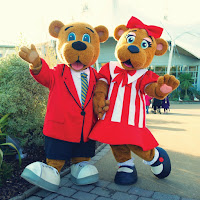
 In 2003 the two mascots in form of bear were created to attract the family. One year later, the new
spa was inaugurated in Skegness. In 2005 the new resort hotel was opened in Bognor Regis and was called “the shore line”. Given the success of the first hotel resort, a new resort was opened in 2009. and was called the ocean hotel.

The aim of the company is and remains the care for the people who are less able to go on with their life. So, in 2008, a few workers of the company made a parachute jump for the charity. They threw themselves from a plane at 100000ft, a little bit more than 30000 meter high.   

In the 2010’s and precisely in 2012 the third hotel was opened in Bognor Regis this hotel was called the Wave hotel. To improve the camp in Skegness a new swimming complex was built in 2013. Last year, in 2017, a village of chalets was built in Minehead at the same time as the seaside apartments in Skegness.

Nowadays the Butlin's holiday camps are more filled than some years ago. This increase of frequentation is explained by the cost of the holidays in Britain: for example, one week in a Butlin holiday camp cost round 800£ and one week in Spain can easily reach 3000£ so the difference of price is huge and even If the sky is in Britain greyer and the beach with less sand it is also possible to enjoy the holidays. Pre- booking for 2018 are by the way in augmentation of 18%. This augmentation is explained by the fact that people are still afraid about terrorist's attacks and they prefer remaining in their country because they find it safer. It can also be explained by the economy (foreign destination are more expensive).

Conclusion:

Even if the Butlin's head has changed through the years, the company remains one of the most competitive in the UK and is still focused on the well-being of hard-workers families in Britain.

Robin Grégoire, Gaëlle Salpeteur, Maxime Tielemans


Sources
Images :

R.E.M, the famous American rock band


In 1980, Michael Stipe met Peter Buck in Georgia. They discovered that they both loved the same kind of music and began to work together. A bit later, they met Bill Berry and Mike Mills, who had been playing music together for years. The first time they played all together was in 1980 in Athens, Georgia. They had several names but they finally opted for “R.E.M”, which is an acronym for Rapid Eye Movement that “Stipe selected at random from a dictionary”1. Their first single, Radio Free Europe, was released in 1981 and their first album, Murmur, in 1983. After their album Document, R.E.M became one of the world's most popular rock bands. The group released their most successful album, Out of Time in 1991. The video for Out of Time's “Losing my Religion” became one of MTV's most popular videos. In 1997, the drummer Bill Berry left the band, but to avoid the break-up of the group after his departure, he was replaced by a drum machine. In 2007, they were inducted into the Rock and Roll Hall of Fame. They released fifteen albums during their entire career and they also won multiple Grammys. The trio announced that they were officially splitting up after 31 years of existence in 2011, the year they released their last album, Collapse into Now. R.E.M is usually said to be the most popular alternative rock band and the pioneer of the genre.The group seems indeed to have greatly influenced this kind of music throughout their career. But what does the term “alternative rock” mean?


      Alternative rock is a musical genre derived from others such as post-punk or punk-rock. It emerged in the USA and in the UK in the middle of the eighties, in opposition to the success of the commercial music of the time. The genre is quite free and does not really have specific characteristics except for the fact that its main instruments include guitar, bass and drums. However, Peter Buck, the guitarist of the band, describes their musical style as minor key, mid-tempo semi-folk-rock ballads. R.E.M has mostly been influenced by other rock bands from the eighties such as the very famous Beach Boys, The Byrds and The Rolling Stones.It is indeed easy to notice how close their styles are. R.E.M’s vocals, which sometimes sound like mumbles, make the lyrics remain quite enigmatic and difficult to understand.


     R.E.M. is considered to be the most engaged band in the United States. All the members shared the same liberal and progressive outlook but they were not always “on the same page” about their ideas. The group raised funds for different causes such as the environment, feminism, human rights and voter registration. During their performances, they often spoke to their audience about socio-political issues. Even though the best way to share their opinion remains music (as in Final Straw or Losing My Religion), they had original ways to pass on their message: during shows on national television, for example, they wore T-Shirts with slogans on them that said “Rainforest”, “Love knows no colours” or “Handgun control now”. To conclude, R.E.M has become a very popular rock band and even though the group has broken up, it still remains an icon of American culture.


Caroline Rabozée, Ilona Ringuet and Léa Varet


Sources


The beaver as national symbol of Canada


“The Beaver in his sagacity, his industry, his ingenuity, and his perseverance, is a most respectable animal: a much better emblem for Canada than the rapacious eagle or even the lordly lion.”, claimed Sir William Dawson, a Canadian geologist and university administrator in his book called The Duties of Educated Young Men in British America. Although the beaver as one of the symbols of Canada has been the subject of debate, it received the royal assent in 1975. But in the end, why is the beaver the symbol of Canada?


The beaver is a herbivorous mammal that weighs between 16 and 35 kilos, and can measure up to 1.3 meters. It is primarily nocturnal, and lives a semi-aquatic life. The beaver is vegetarian, eating both aquatic and grass plants.

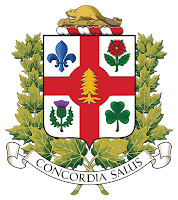
The beaver is an official symbol of the sovereignty of Canada, having received royal assent in 1975. However, it was a part of the Canadian identity long before Parliament passed the National Symbol of Canada Act. Over time, the image of the beaver was used in other coats of arms (like that of Montreal’s) and it appeared on the first Canadian postage stamp, the « Three Penny Beaver » of 1851. After that the decline in use was evident in Canada. Companies and government used the image of the beaver for representative and monetary purposes, because the beaver lived in every province of Canada.

Emblem of the coat of arms 
Historically, the beaver was central to Canada’s beginnings. In the 1600’s and early 1700’s, the beaver became an animal in much demand due to the fur trade. Fur hats became extremely fashionable in Europe. Because North America had a massive beaver population, English and French traders soon became the biggest predators of the beaver. They sold it at a cheaper price than the original one of the North American aboriginals. This lucrative fur trade was the basis of the North American colonies. Due to this market, the beaver almost went extinct. However, thanks to many protective measures, the beaver population reappeared across Canada once again. It was in 1673 that the beaver was first suggested to the authorities as the symbol of Canada.


The beaver’s merits as the national symbol has been debated for a long time. On one hand, some historians claim that it has a rather negative connotation, because the beaver was used for the economy by the crafty natives who found good deals and almost led the animal to extinction. On the other hand, the director of archaeology and history at the Canadian Museum of History in Hull has declared that the beaver reflects the character of the Indian population: hard-working, unassuming and unaggressive.

The beaver has an incredible biological importance. Without beavers’ dams, much of the water of Canada’s streams would flow without any control through the landscape. By diverting water and felling trees, they provide themselves with wood and food but also give access to dense woods, creating opportunities for a variety of animals and plants. For these reasons, they are one of the most important animal species of the Boreal Forest.


Although the beaver has been debated for its role as the national symbol of Canada, it is still and will be a representative for Canada, thanks to its character and importance for the environment.

Chloé Bourian, Sophie De Gelan, Juliette Depauw


SOURCES