
After five months spent in
Utrecht, a city located in the centre of the Netherlands, it is high time I wrote down 'a few things' about my Erasmus stay. Since I wanted to give a full account I did not pay any attention to the length of this blog entry, which resulted in it being the longest on this blog to my knowledge. Sorry about that but I needed to explain everything.
First of all, when we were asked to state which cities we would like to go to as Erasmus students, I did not choose Utrecht — simply because this destination was not in the list. So I was rather surprised to find out just before the Easter break that I was going to study in Utrecht for five months.
Magali and I were the first students from Namur to go there, so we would be like scouts doing
reconnaissance work.

As to administrative matters we did not meet enormous difficulties because the
University of Utrecht (
Universiteit Utrecht) runs an
International Office devoted to exchange student matters. We filled in the forms, sent pictures and so on, and we were effectively enrolled
before you could say ‘Jack Robinson’. However, since course programmes change from year to year we had to adjust our 'choice of courses' form in order to comply with all requirements. We had to take at least a course in each of the two target languages — obviously — and at least a grammar-oriented course as well as another focusing on literature. Since all courses were worth 7.5
ECTS credits, only three different courses would do to reach the minimum of 21. My final programme consisted of the following three courses (which I will get back to later):
Everything being taken care of by the university, I did not have much to worry about, except finding a room… Prof. Mettewie strongly advised us not to ask for accommodation via the host university for fear of ending up renting a very expensive room shared with another Erasmus student. Instead we would have to look for a room in the private market so as to live with Dutch people. Due to a busy schedule I only started looking in July via a website called
Kamernet.nl. Basically you have to pay:
- € 12.95 to post an advertisement valid for one month (‘urgente oproep’) in which you state that you are looking for a room and present/sell yourself
- € 10 to be able to post ten reactions to housing offers. For instance you spot a place that suits you (e.g. not too far from Utrecht and its surroundings, access to the Internet…) and then you send a reply to that advertisement.
However,
the Dutch have a very different housing system: in Belgium when you are interested in renting a room, you tell the owner and you can immediately have it; in the Netherlands it is the flatmates who choose you. In a way you have to win a contest to get the room — which is totally outrageous in a country praising ‘
equality’ as its main value. (*Cough*) I mean, the idea of selection is in absolute contradiction with that principle of equality, even more so since the Dutch hardly ever take the trouble to write back to tell you why you were not ‘selected for the second round’, so to speak. Indeed, if you do receive an answer you are invited to a ‘
kijkavond’, i.e. an informal meeting with all the (potential) flatmates. Then again you can be discarded like an old smelly shoe if they do not like you. Let me now describe how all of this dreadful machinery ruined my summer holiday.
From July to the beginning of September I sent 36 reactions (i.e. a kind of motivation letter telling the owner why you would like to rent his/her room and why you are the perfect candidate) in total, which means I spent nearly € 40. I always received the same automatic replies:
- Helaas heeft de verhuurder besloten om jou niet uit te nodigen voor een bezichtiging. Geen nood: elke maand worden ruim 6.000 nieuwe, actuele kamers aangeboden op Kamernet.nl. We wensen je veel succes met het vinden van een kamer. We doen elke dag ons best voor je! [My foot, once again, SL.]
- De verhuurder heeft deze kamer van Kamernet.nl verwijderd. Dit kan het volgende betekenen: 1) De verhuurder heeft al voldoende reacties binnen en zal in de komende dagen enkele geschikte kandidaten uitnodigen. 2) De verhuurder heeft al enkele geschikte kandidaten gevonden en heeft geen behoefte aan meer reacties.
When you receive those replies more than 30 times you get depressed, I can tell you. You start wondering whether your proficiency in Dutch is really bad (which would explain why they do not reply) or your hobbies and personality do not appeal to them… I started cursing the Dutch housing system. Only two girls had the ‘kindness’ to send me this :
Beste Simon,
We hebben al een leuke huisgenoot gevonden.
Bedankt voor je reactie en interesse.
Met vriendelijke groeten,
(Signature)
Beste Simon,
bedankt voor het reageren maar wij hebben een keuze kunnen maken.
Met vriendelijke groeten,
(Signature)
Simultaneously I paid for a ‘
urgente oproep’ and prolongated it for a month, which cost about € 25 in total. I was much more successful than through the replies, because I received a bit more than half a dozen offers, some of which were plainly commercial (i.e. already making an appointment and not showing any pictures), while other rooms were simply outrageously expensive, up to € 550 per month — exclusive of Internet, gas, water and electricity costs!
Nevertheless, I also received four serious offers. For the first one it turned out that I was invited to buy the room(!); for the second offer I was invited for the first time to a ‘
kijkavond’. However that day I left home with a bit of delay and I was stuck in a traffic jam (due to an accident involving…
Dutch caravans!) so I called the guy to postpone the meeting. One day later I got an e-mail telling me I did not even have to come because they had found ‘
een gezellig huisgenootje’ in the meantime. This is the moment when I realised that finding a room was basically a contest. The third ‘serious’ offer I received was the following:
Beste Simon, Ik zag op Kamernet.nl dat je woonruimte zoekt. Ik heb het volgende in de aanbieding: ruime kamer in schitterend historisch pand gezellige binnenstad van wijk b duurstede, m tuin, ligbad voorzieningen, goede busverbinding 15 min. met stad Utrecht, in nood mag mijn wagen gebruikt.. Met vriendelijke groeten, Albertha Liewes
As this was the only option I had, I told the lady that I was interested in the room. We made an appointment and so we (my mother and I) rode 200 km to
Wijk bij Duurstede, a picturesque town lying 25 km from Utrecht. When we arrived I already did not like the place very much: I found it had something strange and unpleasant to it — don’t ask me why. We visited the house… and we were stunned (in the literal sense of ‘shocked, unable to react, astonished’):
- the lady was not particularly clean; she was some sort of a painter and poetess;
- the ‘fully-equipped kitchen’ did not even have a fridge;
- the ‘20 vierkante meter’ room was actually much smaller and located in a non-isolated attic. Besides, no bed nor any furniture was provided and the absence of any heating could not remain unnoticed;
- however, there was a chimney in the living room with a large heap of ashes on the floor;
- the bathroom was in a complete state of filth;
- finally, before we 'got the hell out of there' one of her two smelly dogs peed on the floor.
We discussed the rent: she first told us it was € 350 but after we pretended that Belgian rooms (like the French, the Dutch do not call a student room 'kot', but 'kamer') were never as expensive she reluctantly agreed to lower the price to € 300. We left the house telling the lady we had to ask my father’s opinion before taking any decision — which was not true at all, but this way we could 'elude'. On the way back we all kept silent for a while because we were in such a state of shock. There was no way I would rent this room, even if it was the only option I had so far. Once I was home my mother and I knocked back a glass of whisky (a first for both of us) and I sent Mrs Liewes a diplomatic response. The next day she retorted (I keep the layout as it was):
Goedemorgen Simon,
Er is overal centrale verwarming in het huis,
en ik heb een huish hulp verder. (typisch een moederopmerking)
U bent blijkbaar niet bekend met het hollandse systeem.
AArdgas, ! Het huis is juist zo sober ingericht qua stijl,
om het aurhentieke te benadrukken,
het omgekeerde van Belgie waar de ouderwetse pluche kleedjes nog op tafel liggen.
enzov.
De open haard is luxe erbij, de vaatwasser ook.
Gelukkig heb ik mensen voo de huur gevonden!
die de 16de eeuwse sfeer weten te waarderen.
Gr Alberdina Liewes
nb je nederlands was houterig en te formeel
So she dares to complain about my ‘wooden Dutch’ while she makes a lot of spelling mistakes… You will conclude from other examples that the Dutch display all sorts of paradoxes…
One week later I was invited to come and visit a room in
Overvecht (northern suburbs of Utrecht) that a student rented for € 260. So, once again we rode to Utrecht to meet the guy and his flatmates. We chatted a lot, told each other where we came from, which were our hobbies (surprisingly we had a passion for the same films) and that kind of things. However, there was filth all over the place and the bathroom was rather disgusting but I was ready to make an effort and clean it up myself, I thought. I was quite confident about getting the room but I was told that there was another candidate… They could have bothered to tell me that beforehand! Especially because my ‘opponent’ eventually got the room: he looked more desperate than me because he was Italian! Once again I cursed the Dutch.
I felt so helpless. Kamernet.nl did not help me at all although I spent more than 50 euros plus another 100 to go to Utrecht and back again… Being that close to the beginning of the academic year I decided to wait until I got to Utrecht to continue my search for a room. Fortunately, Magali had rapidly found a room (notably thanks to her skills at playing the piano) so she kindly accepted to house me for some time.
I arrived in Utrecht on 3 September with very little enthusiasm left. Magali and I had to meet a 'studieadviseur' to assess our proficiency in Dutch and thanks to her we enrolled for a course (Betekenis
in taalgebruik) which was not open for 'bijvakkers' (i.e. people not studying full course programmes). During the following days we attended a general introduction for all exchange students, an introduction in the Faculty of Arts as well as a city tour with
ESN, the Erasmus Student Network association in Utrecht. Its board members organise all sorts of activities for exchange students throughout the year, like excursions and sports tournaments, and even a tour of Utrecht canals on a canoe.

However, most of these activities were organised on Fridays and since I always had lectures on Fridays I have never been able to attend them. I could have visited Rotterdam, Amsterdam, North Holland and Leiden (among others) and I could have taken part in an excursion abroad — a weekend in Brussels andBruges, which would have been pointless anyway.
Let me get back to my housing problem: on the introduction day in
De Uithof (i.e. the university campus where most of the faculties are located, a bit outside the city) I spotted an advert for a room in
Bilthoven, approximately 8 km from the city centre. I gave the person a phone call and we met on Sunday 8 September. When I entered the apartment I was astonished by its cleanliness. The owner,Mostapha , was a Moroccan immigrant who was very kind and thoughtful. He showed me the room that was about eight to ten square meters and was already equipped with a bed. We then chatted, I explained my problems with finding accommodation, I told him about my studies, etc. I was also surprised when he said I could have the room immediately — definitely the opposite of what I had become used to. He simply wanted two '
logés' to help him pay his own rent. My rent would amount to € 250 all inclusive, which is a trifle in comparison with prohibitive rents everywhere else. I was so pleased with all this (a nice room with a view on a railway, a big fridge, access to the Internet, a television, and a clean and quiet environment) that I accepted to take the room. The very next day I moved in; I was ready to face a whole term in Utrecht.
 2/3 of my room, just after I moved in.
Let's now move on to the teaching system and the courses that I took. First of all you have to know that the semester is split in two '
blokken' of two months each during which entire courses are given. In a way, having a course that lasts only for nine weeks is nice when the material is boring, but it is very annoying, too: you've just started getting used to a particular subject and then suddenly you have to stop… Second, as mentioned above I had three courses:
Dutch Present-Day society and
Betekenis in taalgebruik during the first
blok, and
Introduction to Old and Middle English during the second
blok.
 Dutch Present-Day Society
was a very nice and interesting course which — obviously — discussed the Netherlands ('From
the Queen all the way down to the coffee shops"), especially since it was attended only by exchange students, so that we could learn about each other's opinions during the weekly tutorial. Our teacher, Mrs Besamusca gave very lively lectures to introduce us to some aspects of the Dutch way of life (pragmatism, the '
gedoogbeleid' and so on) and make us think about multiculturalism. We had lots of reading to do and we had to write four essays —
some of which you can read on my blog. Moreover we made
an excursion to
The Hague and visited the
Parliament, among others.
The goal of
Betekenis in taalgebruik was to introduce us (a group of about thirty people, including Magali) to logics applied to language. We started from theories about
sets ('
verzamelingen') and elements and then we built up our logical knowledge so as to be able to decompose sentences and translate them into the logical language (i.e. the so-called '
predicaatlogische taal'; for more information check these entries:
propositional logic and
predicate logic). At first I thought that taking this course was like committing academic suicide, but thanks to the weekly homework and multiple choice quizzes on
WebCT (similar to our
WebCampus, but better) and the explanations of the teacher,
Mr Ruys (whose Dutch accent was really difficult to understand, especially since he mumbled all the time), we finally managed to get this course '
onder de knie'.
During the second
blok I only had to take one course and I opted for
Introduction to Old and Middle English. Although we covered roughly the same topics as in Prof. Delabastita's first year course, our teacher,
Mrs Auer, put more emphasis on analysing whole texts. We read for instance
The Ruin,
The Dream of the Rood,
Beowulf and significant parts from
Chaucer's
Canterbury Tales.
We had a lot of work to do each week, but thanks to that you not only earned marks (home assignments and online tests) but it made the exams look much easier because you had already worked on your course thoroughly.
Before concluding I would like to discuss the top 11 most unpleasant things about my stay in the Netherlands. Indeed, as
ThatGuyWithTheGlasses says: "Why top 11? Because I like to go one step beyond."

11.
Landscape.
As much of the country is below sea level the Dutch have invented ways of protecting themselves against floods by constructing dikes and digging canals, which was part of a process to
gain land on water to house people and grow crops, among others. As a result everything seems artificial in this country — perhaps with the exception of some areas in the south. Moreover everything is flat and the only things that stand out when you look out to the horizon are rare buildings and a couple of forests.
10.
Weather.
The Netherlands have a maritime climate, much like us in theory, but I can tell you that temperatures are much colder in winter. As a consequence when you want to go to the city by bike you'd better wear gloves, a scarf, a warm jacket and something on your head in order not to be frozen when you arrive. What is more it rains at least three times a week and the sun is hardly ever to be seen behind the clouds. Over the course of months it snowed only once (a very thin layer) but it froze so much that you could skate on lakes and canals.
 It was quite peculiar to see ducks and geese walking on ice.
9.
Showers.
You will agree with me when I say — or rather:
Wikipedia says — that
"Showers are separated from the surrounding area through watertight curtains (shower curtain), sliding doors, or folding doors, in order to protect the space from spraying water."
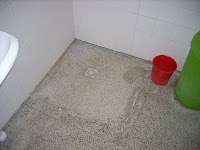
None of the three separations mentioned seem to be used everywhere in the Netherlands (see the picture on the left), resulting in much water all over the bathroom. This is annoying in the sense that you must stick to a rather low flow of water (Dutch thrift, I guess) and then you have to dry the floor afterwards… Moreover, it seems that the Dutch discovered "regular" showers only recently (as you can read on the
Dutch Wikipedia entry):
"Steeds vaker wordt een douchecabine geplaatst, een voorgevormde ruimte met (mat)transparante wanden en deuren en met een geïntegreerde douchebak, als afscherming van de douche."
I'm glad they found it and that they gradually install it everywhere. I wish they also did so with toilets (see below). Just a note before moving on to the next point: I read that "
Nederlanders staan steeds langer onder de douche. In 2008 gemiddeld 8 minuten per dag", i.e. "The Dutch are increasingly taking longer showers, with an average of 8 minutes a day"… Can you imagine what it was before, if it has just risen to only 8 minutes now?!? I guess it has to do with their thrift, as usual.
8.
Expensive public transport fares.
All Dutch students normally get a so-called 'OV-chipkaart' which allows them to use any means of public transport in the whole country — although it is restricted either to week days or to the weekend. However, other people — including exchange students — have to buy a '
strippenkaart' to take the bus. I won't explain how to use it because I would take too long. Train fares are almost prohibitive as well: there is no such thing as a 'Go Pass' to be bought in train stations; the best option is to buy a 'jaarabonnement' for € 55 to get a 40% discount on all train fares, if and only if you take the train after 9 am except on weekends. But still, a fare from Utrecht to Maastricht costs as much as € 15! In Belgium, on the other hand, as a student you'd pay € 4,6 [and I am told it has risen to € 5 in the meantime ;-)] to go anywhere. And Dutch exchange students benefit from this, what an outrage!
7.
Cleanliness.
As you have read above I encountered serious cases of utter filthiness, so I won't repeat myself here, but just say that I was lucky to live with a Moroccan guy. I helped him time and again to keep the apartment in a clean state — which my female flatmate unwittingly tried to ruin. I realise now that I have not told you about Minéa yet; she rented another room from Mostapha and I admit I know very little about her because over the course of five months spent in that flat I met her at most ten times. Indeed she was either absent all day long, coming back at 1 am and making much noise, or she stayed in her room instead of cooking and eating with me. I just know she came from Groningen and that she studied at the Hogeschool Utrecht. Moreover she drank up to 6 cups of that disgusting
Senseo coffee in a single afternoon and she was heavily addicted to cigarettes. I told her I could not stand her smoking but she kept doing it — just in her room, but since walls are as thin as paper the
mephitic stench penetrated my room when she was there. Moreover she never cleaned the kitchen after cooking, resulting in large drops of grease everywhere and a sink clogged by the remains of her meals. Besides, she never washed her hands after going to the toilet; she just rushed to the Senseo machine.
6.
Food.
The Dutch have
traditional dishes like '
stamppot' but I never got the opportunity to try them. Instead I ate the same as in Belgium, not only because I brought a large supply of meat with me (mimicking the Dutch when they go to the Ardennes) but also because you can find everything you want in supermarkets like Albert Heijn, Hema, Dirk or Super De Boer. From September to December you could buy candies for the Sinterklaas period, like '
kruidnoten' (which are cookies, in fact). In December you would also see stands selling '
oliebollen' which are much bigger than the usual Belgian 'croustillons' or 'smoutebollen'. As to chips or fries (whatever you call them), the Dutch like to dub them 'Vlaamse frites' and the common way to order fries with mayonnaise is to say: "
Patat met!". However, never order that because Dutch mayonnaise has a sweet, disgusting taste to it. I had to import mayonnaise from Belgium so as not to be sick. As to fries themselves I did not find them that tasty, probably because they use
Zeeland potatoes instead of the 'bintje'.

What is more, they love soaking them in all kinds of sauces, like
patatje speciaal (special): mayonnaise with spiced ketchup and chopped onions; and
patatje oorlog: mayonnaise and peanut sauce (and ketchup and chopped onions). The Dutch enjoy that, though, as well as any other junkfood they can find: in the station you could eat at as much as a dozen junkfood outlets, not to mention all other similar 'restaurants' in the city — including
KFC, one of the few things (together with non-damaged roads) I regret not having in Belgium.
5.
Paradoxical behaviour.
I have already mentioned a couple of Dutch paradoxes (like praising equality but not giving you a chance to find accommodation), but let me give you a few others.
- First, the Netherlands have set up a so-called 'gedoogbeleid' which allows municipalities not to prosecute soft drugs users in order for the authorities and the police to take care of other criminals who are 'more dangerous for society', like hard drugs users and dealers. So policemen don't 'raid' coffeeshops (which are actually forbidden by law) but prefer handing out fines whenever possible. (Incidentally, speed cameras are a Dutch invention.)
- Second, the Netherlands claim to be one of the most secular nations in Europe, but this does not mean that most of them are atheists; quite the contrary, from what I experienced they have an extensive knowledge of the Bible and their culture is strongly influenced by Calvinist thought, as is the case with their thrift (that is to say: 'spending hard-earned money on earthly goods is bad', if I can sum it up this way).
- Third, the Dutch are keen on standing on the left of escalators so that people (like me) who would like to walk because they are not lazy become blocked. I simply do not understand why they just cannot stand on the right side much like in England for instance. We could think the Dutch do not like to rush or anything, but I have evidence of the opposite: when they ride their bikes they would hardly ever stop when the traffic lights are red.
4.
Toilets.
Most of the toilets that you can find in
the Netherlands have a very peculiar shape and their use is somewhat unpleasant. I found
an account by an American which perfectly sums up my thoughts on this disturbing matter:
Normally, it's good to accept a different culture at face value, and to seek fault as little as possible. The Dutch toilets are just crazy, though, and I still feel that way.
For those who haven't had the priv[i]lege of shitting in The Netherlands, allow me to describe. Instead of a bowl, you have a shelf. That's the simplest description. The shelf has a very shallow bowl-like aspect, and a low curved lip toward the front of the unit, where the flush-tube is.

So, you get to take a good look at your stool.
Then you flush the toilet. (…) When you flush the real Dutch toilet, your stool is supposed to wash down that flush-tube at the front. It doesn't always do that, of course.
There should be a toilet brush. If there isn't, something's missing. The brush is not just for the occasional housecleaning toilet scrub. You have to brush that shelf. You might even have to sort of help push that turd down the flush, sometimes. I mean, you can't leave it there.
So the toilet-brush is soiled, sometimes badly.
I don't like Dutch toilets.
He forgot to mention the smell since the 'stool' is exposed to the air. If you happen to be interested by this highly sociological topic please
watch this instructive video and
read this other account.
3.
Language.
As we know the Dutch have a very peculiar way of speaking their own language: as Prof. Mettewie told us last year the pronunciation of Dutch remained relatively unchanged in Belgium thanks to the BRT (now VRT) standard, while the pronunciation of Dutch in the Netherlands went its own way, resulting in another distribution of diphthongs (as in the
Poldernederlands variant). To use a
Konnex phrase: '
het klinkt me niet als muziek in de oren', I admit, maybe just like I do not like the French accent. Moreover the Dutch tend to use the same words very often; I wrote down a sentence in which they all occur:
"Jaaaaaa, nou, volgens mij is het toch gewoon lekker gezellig of zo, weet je, zeg maar."
'
Zeg maar' itself seems to be the most
en vogue idiom nowadays because the Dutch (unconsciously) use it at the end of (nearly) all their sentences, which becomes very irritating if you are obsessed by it like me. (By the way, French-speaking people now overuse such irritating chunks as '
tu vois ?' and '
quoi' — it really drives me crazy!) What is more, the Dutch usually have a very good command of English, except that they either speak it with a strong American (perhaps due to the so-called '
Gooise r') or Scottish accent (because of the frequent use of the /
ʃ/ phoneme in Dutch Dutch).
2.
Trains.

Apart from the fact that train fares are prohibitively expensive (see above), there is something else that upsets me about the NS (or '
Nederlandse Spoorwegen'): most of their trains feature so-called silent passenger cars, which is really a good idea. However, the Dutch seem not to notice they exist (nor the big signs indicating 'STILTE' and 'SILENCE'). I remember that once, as I was trying to understand some difficult course material, a group of four old people talked loudly and eventually noticed they were in a silent car, but they blatantly kept on talking! My advice is to go to a non-silent car in order to get some peace and quiet.
1.
Snot.
As it is always very cold outside it is normal that everyone catches a cold. But what I find extremely annoying is that the Dutch never blow their nose but prefer to sniff in their mucus. Once I noticed that phenomenon I became obsessed by it and this was a torture when I sat my Old English exam: I was in the middle of 150 Dutch students, and I could hear someone sniffing about every single second. Apparently this bad habit is restricted to the Northern part of the Netherlands, because I did see people blowing their noses in Maastricht. Prof. Leijnse's hypothesis is that this all has to do with a less important conception of hygiene in the Netherlands, and this would explain many of the unpleasant experiences that I mentioned above.
But, as
Konnex would say: "
's Lands wijs, 's lands eer".
All in all I have mixed feelings about my Erasmus stay:
- on the one hand I delighted in that excellent university and in the courses that I took: I learnt a lot about the Netherlands, semantics and logics as well as about Old and Middle English, and I got good marks at the end;
- on the other hand I was quite bitterly disappointed by the cultural side of the stay: I did not live with other exchange students so I did not see them very often (which is sad, because I met very nice people like Aslak, a Dutch-speaking Norwegian student), and I hardly ever talked to my two flatmates. I did not make any contacts with Dutch people, except for a woman next to whom I sat when attending Old and Middle English classes, but although I always spoke Dutch she replied in English… I spoke more Dutch when I attended the Christmas Party in Namur than in Utrecht. Hence all the bitterness in what I wrote in this blog entry.
I am glad I took part in this kind of adventure although I regret some of its outcomes. At least I learnt a lot about the Dutch way of life and this strenghtens my opinion that Belgium is the best country in the world. I hope that the students who will succeed Magali and myself in Utrecht will take good note of this account so that they have a more fulfilling stay.
– Simon
PS. Please browse through
the blog that Magali and I kept to see more pictures.
[Note: this blog entry was edited according to Professor Vandelanotte's corrections and suggestions on 2 February 2009. Sorry for those of you who read some shameful mistakes that are due to a lack of focus when writing the post.]


 Let’s start with a little piece of advice to all you future Erasmus students out there! The first thing to do after you have been selected for the Erasmus-adventure is to look for a student room because these are very hard to find! Luckily Ana found accommodations for both of us in a small city (just outside of Cologne) named Hürth. Our lodgings were absolutely perfect; we shared our little house with a very nice and helpful German girl called Janne and a Chinese girl (Su), whose main occupation was eating! Unfortunately Su only spoke ‘Chinese English’, a version hard to understand for anyone who hasn’t resided in Asia for at least a decade. I didn’t spend a lot of time with her; so my English hasn’t changed for the worse!!! As for the German language, I practiced it with Janne and the other Erasmus-students who lived in the area.
 Unlike Namur Cologne is quite a big city. It has a lot to offer. That is why we were very grateful for the numerous means of public transport that we could use. Indeed it only took us 30 minutes by railway to reach the centre of Cologne. Once there, you are tempted by the many shops, museums, restaurants, snacks-bars and of course the cathedral, the famous ‘Kölner Dom’, which is one of the symbols of the city. When we found out that you could get to the top of the cathedral, we decided to give it a go! So on a sportive day, Ana, Benjamin (who was there on a visit) and I climbed the 509 steps to the top in 20 minutes (Benjamin did in 15 minutes). When we finally arrived, we were met by the most beautiful panorama over the city and its surroundings stretching as far as the eye could see. After this tiring but rewarding exercise, we spend the rest of the day in a more relaxed way, namely by visiting the zoo!!
 On a more serious matter, we discovered that the academic system in Cologne is not exactly the same as in Namur. First, you have to choose your own courses as well as register for them online. Believe me this is not as easy as it sounds. I’ll spare you the details but let’s just say that I spent a lot of time on the internet trying to understand the complicated German system. Secondly, Germany isn’t fully aware of the ECTS points! This caused quite a problem when we had to explain to the various professors that we needed X credits points! Most of them seemed to know what we were talking about; but others just answered “Keine Ahnung!” (No idea). Another problem we encountered was the fact that in Germany the first semester only finishes in February, whereas in Namur the second one already starts on January 26th! So Ana and I spent our last Erasmus week trying to explain to everyone that we really needed our papers as soon as possible because we had to return back to Belgium. Quite exhausting!


