Monday, April 25, 2011

Rowan Gillespie

Rowan Gillespie is an Irish sculptor famous for his contemporary works, using the lost wax (or bronze casting) process. He works totally unassisted and his exhibitions, particularly his site specific works, are now well-known in the world.

Born in Dublin in 1953, he lived in Cyprus about ten years during his childhood. He entered the York School of Arts at the age of 16 and then studied arts in Oslo during three years. Rowan Gillespie’s works are exhibited in big cities all around the world since 1977: we find them in York, Dublin but also London, Los Angeles and Stockholm. He started exhibitions in groups and festivals in 1982. After 1997, Gillespie decided to concentrate on his personal works, site specific art and public sculptures. In 2011, the famous sculptor was elected on the board of the Irish Museum of Modern Arts after having been awarded honorary Doctorate of Fine Arts some years before.

His most famous works are Yeats, James Joyce, Famine and Proclamation.

Famine (1997) is the name of a bronze sculpture found in Dublin along the Liffey River. It recalls people the Irish Potato Famine which devastated Ireland in the 19th century, killing about a million people. A quart of the population died or emigrated from the country and this event profoundly marked the Irish community. This is an important theme found in many works of the artist. Famine is a commemoration of the suffering and starvation of this people. Rowan Gillespie tries to portray the human emotions in most of his works and Famine is one of the most famous sculptures because of the intensity of the statues’ expressions. Six horrified faces, six people, men and women trying to escape from this dreadful death perhaps on their way to a ship.


Less realistic and more recent, Proclamation (2007) is another well-known work of Gillespie found in Dublin. Inspired by John Lennon’s Imagine and by J. Creed Meredith’s Rainbow in the Valley, the sculpture recalls the Irish emancipation and independence. Fourteen martyrs are put in circle and a copy of the Declaration of Independence is placed at the centre. Bullet holes in the statues represent the execution of people trying to fight for their vision of a better future. “Imagination is the beginning of creation”, the creation of what you desire to happen. There are no different faces, sign of unity, and the multi-faceted surfaces reflect the light in different ways, giving the colors of the rainbow. Proclamation is a fabulous metaphor of imagination and a monument to martyrs who gave their lives for what they thought to be right.

Tracey Emin

Tracey Emin is an English artist and, together with Damien Hirst, one of the leading representatives of a group known as the Britartists or the YBAs (Young British Artists). These visual artists are (in)famous for their ‘shock tactics’, their use of throwaway materials. They earned fame during the 1990s.

During her early life in Margate, the economic situation of her family deteriorated. Her work often reflects this critical period of her childhood. She also wrote a book about all those childhood memories (Exploration of the Soul).

In 1994, her life as a contemporary artist really began and she directly imposed her trademark, namely works that are typically autobiographical. Her relationship with the then already famous Carl Freedman pushed her to create one of her best known works: Everyone I Have Ever Slept With 1963-1995, a real piece about intimacy.

The artist has been active in various fields: monoprinting, painting, photography, etc. But she remains famous especially for the two artworks, which she called “My seminal pieces”: Everyone I Have Ever Slept With 1963–1995 and My Bed.

Everyone I Have Ever Slept With 1963-1995, also known as The Tent, was created in 1995 and consisted of a blue tent in which the names of all the people she has slept with between 1963 and 1995, were appliquéd. No sexual connotation has to be understood, and that is why it got very bad press. She simply meant everyone such as her parents, childhood friends, adult mates, as well as her unborn foetus. This artwork is very intimate because the viewer is invited to go into the tent, to kneel inside of it in order to see the names. On the floor one can read "With myself, always myself, never forgetting", by which she shows that this is not an ordinary tent; it is her tent. The work was destroyed in the 2004 Momart London warehouse fire, but she refused to recreate it.

My Bed was presented at the Tate Gallery in 1999 and was shortlisted for the Turner Prize the same year. It consists of her unmade bed from which she did not get up for several days after a period of depression. It is made up of her bed with stained bed sheets and every day objects for example a blue rug, a pillow, and empty bottles of alcohol. But the most shocking part was the other things like used condoms, a stained pair of knickers and garbage. Through this artwork, Tracey Emin reveals, once again (cf.: Everyone I Have Ever Slept With 1963-1995) her own personal space, her own privacy and her own emotions. "She shows that she is as insecure and imperfect as the rest of the world".

Morgane Hazard & Julien Leclercq.

Grayson Perry : portrait of a potter in frocks

Grayson Perry is an English artist known mainly for his ceramic vases and various works in arts en crafts. Next to his earthenwares, Perry also acquired popularity using other media (printmaking, drawing, photography, ...) but especially because of his tendencies to dress in women's clothes. His works often depict dark subjects (e.g. child abuse, sado-masochism, transvestism, ...) in which images of Perry's female alter-ego, Claire, often appear. All of his oeuvre can be understood more easily at the light of some biographical facts.

Grayson Perry was born in Chelmsford on 24th March 1960. At the age of 7 his father left the house because of his wife's cheating on him (event that Perry describes as the one that has had the largest impact on him in his whole life). Soon after that, the young Grayson will have to cope with a new family and violent stepfather from who he escapes by inventing himself an imaginary world. At the age of 15, Grayson moves to his father's house where he begins going out dressed as a woman but he is soon spotted by his stepmother and thrown out of the house. A few years later, he gives up his dream of joining the army and gets into art on the advice of his art teacher. After his graduation in 1982 at Portsmouth Polytechnic, the young artist begins a hand-to-mouth life; his stepfather had told him never to return home again. After a few pottery lessons in 1983, Perry took his own path and began to expose his work individually. Thanks to the success of an exhibition at the Stedelijk Museum in Amsterdam, Perry was awarded the Turner Prize in 2003, the first time it was given to a ceramic artist. Perry attended the award-ceremony dressed up in his alter-ego, Claire. An autobiographical account of his formative years, entitled 'Portrait of the Artist as a Young Girl' (co-written with Wendy Jones), was published in 2006. The book makes a clear reference to James Joyce's famous novel 'Portrait of the Artist as a Young man' and to Perry's gender-bender experiences.

'We've found the body of your child' is no doubt one of Perry's most controversial work. This vase depicts scenes of death and grief on a glazed silver and golden background, all along with statements such as "All men are bastards", "You fucking little slut", "Cry baby", ... Altogether this vase hints a fierce critique against paedophilia en child abuse.

In 'A map of an Englishman', Perry charts his own mind as an imaginary island, roughly brain-shapped and surrounded by various seas (e.g. Schizophrenia, Delirium, Anorexia Nervosa, ...). The countryside, on the other hand, is divided in many regions, each of which is dotted with a church (e.g. Pride, Bad Day, ...). Other geographical entities are also named in the same fashion. All these names altogether give a fascinating insight into Perry's inner thoughts and neuroses.


Keith Haring

«He was born face up, (...) I should have known right then something was gonna be...upper! », said Keith's mother laughing.

Keith Haring was born on May 4, 1958 in Reading, Pennsylvania (U.S.). At a very early age, he got interested in drawing, learning the basic skills from his father. When he was 19, he moved to New York where he studied at the School of Visual Arts but he got his artistic training in the streets and the shabby parts of the city as well.

The 1980s were a time of prosperity and new hopes for the American dream. There was an obvious need for social changes which was expressed by young people leaving their marks on the walls of the city. The new message required a new vocabulary: graffiti. This visual language allowed Haring to gain his first public attention. Those simple images, with bold lines, vivid colours and active figures can function as words. Their symbolic values of birth, death, love, war... appeal to a wide range of people and are generic enough to be understood by everyone. Those signs are universal: they are for every culture and make sense at every moment in history. This is the reason why they are so powerful and have gained national and then international recognition by the media.

The idea of drawing in subway stations came to him in a flash when he noticed an empty black panel. Drawing there on unused advertising panels was a way to give art a new life and to make it easily accessible to everyone. So he was able to bring artwork to all sorts of people, even those who never went to museums. He made hundreds of these public drawings between 1980 and 1985, sometimes producing as many as forty “subway drawings” in one day. Other famous places on which he painted include the western side of the Berlin Wall in 1986 (3 years before its fall), exteriors of hospitals in the United States and in Europe. He also created a mural for the 100th anniversary of the Statue of Liberty on which he worked with 900 children. As his fame grew, he welcomed the chance to take his work to even more places. So he participated in international exhibitions, a good opportunity for him to travel and experience other cultures. Aboriginal and African art, among other things, have influenced his work. He was also inspired by Walt Disney and by Andy Warhol, a leading figure in the pop art.

In 1986, he opened the Pop Shop, a retail store in Soho where T-shirts, toys, magnets, posters, buttons are for sale. By selling low cost products, he made his art available for the greatest possible number of people.

Shortly before he died of AIDS, at the age of 31, he established “The Keith Haring Foundation”. Its aims are to protect and expand the audience for his artwork providing information about his life and work but also to give financial assistance to non-profit-making organizations he used to help when he was still alive.

Service announcement

You may have noticed the blog lay-out was updated -- after five years it seemed right to update the look and feel of the blog a little bit. Even if blogging has perhaps been going out of fashion somewhat in this facebook day and age, it still serves its purpose for this particular germ@namur blog. You can use the permanent links on the right hand side to navigate (among other things) to the indexing sites collecting the two main types of contributions: Erasmus testimonials and keywords and icons of anglophone cultures (with occasional specials).

Note that the current post, as well as many older ones (for instance back in the blog's inaugural year), features the styles that form part of the template for the blog. Many recent posts feature outlandish fonts which do not fit the template as well. The reason for this (in all likelihood) is that some of you prepare the blog texts in Microsoft Word and then copy and paste them into the Blogger editor. Unfortunately, Word adds a lot of html clutter without your noticing, and this interferes with the style settings of this blog. There are two main ways to avoid this that I can think of:
  1. type or retype your text directly into the Blogger editor and add in any links, pictures, videos, etc. from there (preferably without changing fonts and font sizes so as to maximize the whole website's coherence in terms of styles and formatting)
  2. if you have prepared your text in Word, copy and paste it from Word into Notepad (the ubiquitous standard Windows accessory) or a comparably basic Mac text editor, save this txt document temporarily, and then copy and paste from this (automatically completely stripped-down) version, which should then be free from all the clutter, into the Blogger editor to add links, pictures and so on in a final step.
Meanwhile, thanks for all your excellent contributions!

P.S.  There was a problem with one contribution of which the excessive Word html codes upset the general template settings (link styles) so I've had to remove and rewrite this post to avoid the problem.

Douglas Gordon

Douglas Gordon was born on 20 September 1966 in Glasgow, Scotland and is still alive. He was brought up in a strict religious family. His mother was Jehovah’s witness and he often accompanied her to preach door-to-door. He graduated in 1990 at the Slade School of Art in London after studying at the Glasgow School of Art.

This famous video artist was revealed to the public thanks to his work « 24 Hour Psycho » which he won the Tuner Prize for in 1996. The film was produced in 1993 and is a slow motion film version of Hitchcock’s Psycho. The original version lasts 109 minutes with 24 frames a second whereas this one uses only 2 frames a second and therefore lasts 24 hours. After a few years he eventually considered this film as a mistake and reworked it. The remake, “One Minute Psycho”, is a one-minute fast motion version of it.

Gordon has more recently realised “Zidane: a 21st century portrait”, a documentary about the famous football player and “k.364”, his latest creation. “K.364” was to be seen last month during an exhibition at the Gagosian gallery in London. Douglas Gordon excels in other fields of art (sculpture, photography…) and his exhibitions attract a lot of people all over the world. One of his most famous works of art is undoubtedly « List of Names », a project initiated in 1990. It consists of an almost exhaustive list of the people the artist remembers to have met during his lifetime. It is currently exposed in the “Musée d’art moderne de la ville de Paris”.

Gordon has a very particular style. He often uses new video techniques and plays with time elements. In “Through a looking glass” he works on a famous monologue of Robert de Niro in the film Taxi driver. De Niro is talking to a mirror and asking it “You talkin’ to me?” For his adaptation, Gordon uses two facing screens: one projection representing the original film sequence, the reflection in the mirror, while the other one is a reversed image of the scene. The two images begin synchronically but they progressively differ, giving the impression that they respond to one another and echoing the mental disorder of the character. Duality and repetitions of the time characterize this film but also the style of Douglas Gordon in general.

Angèle Mars & Simon Nulens

Angus Fairhurst; doomed to be remembered for his suicide or great artist?


Angus Fairhurst, born in Kent in 1966, was one of the Young British Artists. Like most of them, he went to Goldsmith's college and set the tone for contemporary art in the United Kingdom for two decades. He took part in the 1988 exhibition Freeze, the seminal event for the YBAs. In 2008, he commited suicide at the age of 48 by hanging himself in a wood at the last day of his exhibition at the Sadie Coles Gallery.


His entire oeuvre shows that he was a versatile artist; his paintings, performance, animation, photography, video, sculpture, music, prints, drawings and collages show his resistance to categorisation. Fairhurst was fascinated by the absurdity of life and art. We live our lives, without thinking too much about it; we are born, we wake up, we work, we sleep and we die.


In his work, he is also inspired by sex, desire, advertising and society. Turning around the question of art, he realised that he was part of the art world but at the same time he didn't take it too serious. A famous example of this view is the play with the two phones in his "Gallery connections". Fairhurst rang two different galeries simultaneously, held the handsets together, let them talk to each other and put the Gallery scene in London upside down.


Fairhurst had a passion for gorillas, in his art they are often represented in a very domestic situation. "A Couple of Differences between Thinking and Feeling" (2003) shows a gorilla looking at his detached arm lying on the ground.


As the director of Tate Britain, Stephen Deuchar said "Angus's death is a tragic loss to British art. He was a brilliantly inventive, witty and provocative artist, always modest about his fundamentally important contribution to the soaring international reputation of British art since the 1990's."


“The pop idea was that anybody could do anything” Andy Warhol

Andy Warhol (Andrew Warhola) was born on 6 August 1928 in Pittsburgh. His parents emigrated from what is known today as Slovakia. Andy received his first camera when he was 9 and his interest in photography began to develop. He studied at Carnegie Institute of Technology from 1945 to 1949 and got a Bachelor of Fine Arts degree in Pictorial Design.

After graduation, Andy Warhol went to New York and started a career as a commercial illustrator in Glamour magazine. He rapidly made a name for himself and became one of the most successful commercial illustrators of the 1950’s.

In the late 50’s, he began to make his first pop paintings inspired by comics and commercials.

Campbell soup
During the 1960’s, he painted iconic American products such as the Campbell’s Soup cans, also referred to as the 32 Campbell’s Soup Cans. This work of art is composed of 32 canvases depicting a Campbell’s Soup can. Each canvas differs from the others, representing one of the 32 varieties of soup that the company offered at the time.


Marilyn Monroe
Marilyn Monroe was a famous American actress, model and singer who overdosed in 1962 when she was only 36. At the same time, Andy Warhol was very well-known for his Pop-Art. Marilyn’s death also marked Warhol’s first use of silkscreen printing or screen-printed paintings. That is, Warhol painted on photographs glued onto silkscreen. He said: "It was all so simple quick and chancy. I was thrilled with it. When Marilyn Monroe happened to die that month, I got the idea to make screens of her beautiful face the first Marilyn’s". He then made a large series of portraits of Marilyn.

In the 1960’s he also devoted time to the realization of films: Empire (1964), The Chelsea Girls (1966), and the Screen Tests (1964-66). Warhol opened his first studio in New-York in 1964 for an exhibition of sculptures. It was called ‘The Factory’ and rapidly became the place to be.

The 1970’s saw the large-scale publication of books about Pop Art in which Andy Warhol gives his own view on it. By that time he had reached what we might call ‘the height of his fame’ and the ‘commercial’ period because of the abundance of commissioned painted portraits for wealthy people. The popularity of his ‘celebrity portraits’ enabled him to have a comfortable financial situation.

During the 1980’s, Andy Warhol regained critical success thanks to his collaboration with artists such as Jean-Michel Basquiat, Francesco Clemente and Keith Haring. By then he had also started to work as a TV producer (Andy Warhol’s T.V. or the Andy Warhol’s Fifteen Minutes). He was of course still very active as a painter and towards the end of his life he created a series of paintings representing The Last Supper. These paintings were part of his last exhibition which took place in Milan in 1987. A month later, the artist died after suffering a cardiac arrest at the age of 58 years old.
Warhol may be one of the most respected artists of all times, we should keep in mind that this was not always the case.


Justine Dumont & Emmanuel Duquesne

Tracey Moffatt - Something More

Tracey Moffatt is the most famous Australian photographer and film-maker. Born in Brisbane, she graduated from the Queensland College of Art in 1982. She directed documentaries and music videos till she became famous with her series of photographs Something more in 1989. Her works are shown in a lot of museums, including the Tate, the Museum of Contemporary Art in Los Angeles or the National Gallery of Australia.
Something more is a series of six direct positive colour and three gelatin silver photographs. It tells the story of an Aboriginal girl -played by the artist- who wants ‘something more’ out of her life in the back-blocks. Looking for a new identity and a world of luxuary, the girl visits a place inhabited by rough people. She is eventually disappointed and she turns into a thief. After a sadistic lesbian relationship, she tries to escape the place, but she dies on the road. Using the style of a set of stills and the technique of staged photography, the series deals with sexual slavery, domination and exploitation of the natives. 
Since 1989, Tracey Moffatt has also published a lot of other series, including Up in the Sky (1997), Fourth (2001), the Adventure Series (2004) or more recently, the First Jobs series (2008), where she describes her ‘dreadful’ student jobs. In 2007, she received the Infinity Award for Art by the Center of Photography in New-York, which honours artists with a distinguished career.
Tracey Moffatt has also shot short films and experimental videos. Her short movie Night Cries: A Rural Tragedy was selected for the 1990 Cannes Film Festival. It tells the story of a middle-aged Aboriginal woman, isolated in rural Australia and nursing her old white mother. Frustrated by her sense of duty, the woman will eventually feel lost when her mother dies.
Her first feature film, beDevil, was also selected for Cannes in 1993. The plot consists of three ghost stories in which the Aboriginal and Anglo-Celtic characters are haunted by the past and bewitched by memories. Dealing with racial stereotypes in Australian rural society, Tracey Moffatt also shows us how native and non-indigenous people understand and live with each other.
Next to Night Cries and beDevil, which were internationally acclaimed, the artist also made Heaven, a movie dealing with surf, sex roles and voyeurism, as well as a few politically committed films, including LIP and Other.


Louise Bourgeois


Louise Bourgeois is a famous French-American artist best known for her contributions to modern and contemporary art. She was born on 25 December 1911 in Paris and died on 31 May 2010 in New York. She moved to New York in 1938 after marrying the American art historian, Robert Goldwater. She had to wait until a retrospective at the Museum of Modern Art in 1982 for recognition. Her surrealist and abstract works, based on emotion and childhood memories, defy classification. Bourgeois was indeed not considered important enough to be included in a comprehensive survey of American art in the 20th century in 1993 by the Royal Academy. Many art critics consider her symbolism too obvious

Her art is indeed almost exclusively autobiographical, confiding to the world her trauma of discovering at the age of 11 that her governess was also her father’s mistress. It is this ‘Oedipal mess’ that underlies most of her works. As a consequence, the language of psychoanalysis is perhaps more adequate than the language of art to analyze her ‘confessional art’.

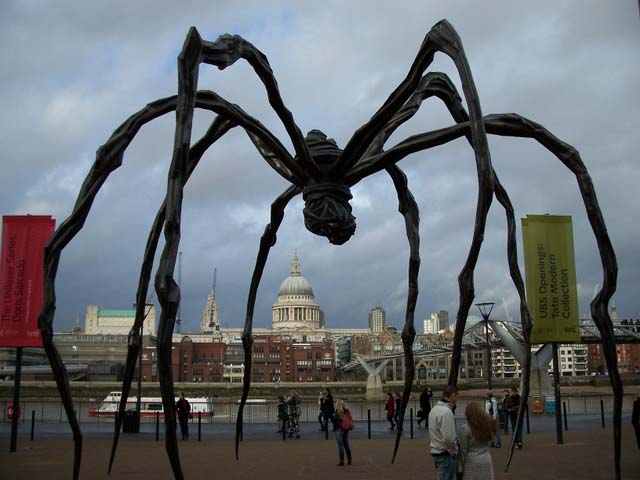
However, despite criticism from among others the Royal Academy, she had become an A-list celebrity’ by the 90s. One of her most famous works is undoubtedly “Mother”, the immense spider that she had been creating since 1994 in different places such as London, Bilbao, and Seoul.

Louise Bourgeois identified this spider with her mother ‘because my best friend was my mother and she was as intelligent, patient, clean and useful, reasonable, indispensable, as a spider. She was capable of defending herself.’ Spiders also spin webs, which refers to her mother’s work of repairing tapestries. She put into her works a ‘web’ of memories that she unraveled from her childhood to exorcise them and to transform her anxiety into pleasure. That paradox between monstrosity and reassuring maternal figure is characteristic of her artwork. "Le jour où je n'aurai plus rien à exorciser, je n'aurai plus qu'à me taire."

Vivian COLLARD & Martin GERARD

Thursday, April 21, 2011

Ben Frost


Ben Frost is a post-modern Australian pop artist born in Brisbane in 1975. His work consists in controversial and confrontational juxtapositions of iconic images. These are taken from the worlds of advertising, entertainment and politics. With his work Ben Frost wants to challenge contemporary norms and values of Western culture and society. He was rewarded with the ‘Karl and Gertrude Langer Memorial Award for Highest Overall Score, Qld College of Art’ in 1996. He also won the ‘Winner Painting Category, Churchie Exhibition Of Emerging Art’ in 1997 and 1998.


The painting ‘White Children Playing in the Late 1900s’ shows two children. A kneeling young girl uses a cigarette lighter to heat drugs in a spoon held by a young boy. The girl also has syringes in one hand. You can see an aircarft coming down in the corner: it is likely to crash on the children. The painting owner is Michael Notman. It was painted in June 1995 and it is considered as an anti-drugs piece. It is quite a controversial painting, probably censored. That is why it is not easy to find a picture of it on the Internet.


‘Ben Frost is dead’ is the title of his most famous solo exhibition. It took place in 2000. On that occasion, he sent his invitations in the form of newspaper funeral notice, which made everyone believe that he was dead. It was much criticised because it coincided with the death of another artist.


The term ‘Colossus’ refers to his exhibition in collaboration with Roderick Bunter. Society’s continuing loss of innocence is one of the themes he deals with. During another exhibition, the painting ‘Where Do You Want To Go Today ?’ was removed due to its provocation. From 2002 up to now Ben Frost has kept on exhibiting in other cities, like Tokyo and Sidney.


As stated above, Frost's work is made of juxtapositions of different elements; for example, Disney characters, Hello Kitty, the Simpsons. Ben Frost manipulates the techniques of advertising from everyday life and turns them into something not convincing but rather provocative. A lot of people around the world are fans of his paintings, even though these latter are quite unconventional.

Thursday, April 07, 2011

Jeff KOON$

Jeff Koons is an American artist. He was born in 1955 and graduated from Maryland Institute College of Art in Baltimore. He first worked as a Wall Street commodities broker before picking up the threads of his art career. He started his searing rise back in the 1980’s by using objects from the consumer world. Like Marcel Duchamp with his Readymades and Andy “Campbell Soup” Warhol already did before him, Koons uses the all American iconography such as kitschy toys, cartoons, vacuum cleaners, inflatable plastic flowers, and so on and turns them into controversial high art raising questions about the limits and the conception of art itself. Koons himself has stated that there are no hidden meanings in his works: “A viewer might first see irony in my work but I see none at all”. For him, the creation must simply be taken at face value.

There is sensationalism, exhibitionism and provocation in the Koons phenomenon. In 1991 he married Ilona Staller ("La Cicciolina"), a notorious Italian porn actress, politician and singer who continued to make hard-core pornographic films while in office. The marriage resulted in Koons' sexually explicit Kama Sutra Glass Sculptures first and in a divorce afterwards. Art critics are divided in their views of Koons. For some he is a pioneer and a major artist of historical importance. For others he is a narcissistic self-promoter using kitsch and shock tactics. But in any case the artist draws the attention to himself.

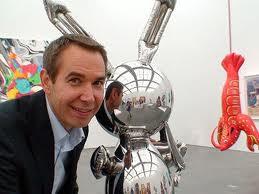
Among Jeff Koons’ most notable artworks are the Balloon Dogs. They exist in 5 “unique” versions (Blue, Magenta, Yellow, Orange, Red) and are made of high chromium stainless steel with a transparent colour coating. They are 121 inches (307,3 cm) high and weigh... a lot although they look as if they could float at any moment. Another of his works, which has also become an icon of the neo-pop style, is his porcelain Michael Jackson and Bubbles. Man and monkey are both dressed in a golden suit and gazing with the same empty eyes. For this famous creation he drew his inspiration from a knickknack on display in a tourist store. Koons' works have sold for astronomical prices at auctions. In 2001, one of his 3 Michael Jackson and Bubbles porcelain sculptures sold for $5.6 million.

However, this neo-pop artist is not very dexterous. He scribbles down notes and ideas, which are not carried out by the master himself but by a team of European craftsmen together with the 100 assistants who work at his studio. This results in luxurious quality and flawless execution of his works. In an interview, Koons described his work this way: “I’m basically the idea person. I’m not physically involved in the production. I don’t have the necessary abilities, so I go to the top people…”. For this reason some of his detractors prefer to call him an entrepreneur rather than an artist.

Marie Gillet & Myriam Carlier

Monday, April 04, 2011

Damien Hirst


Damien Hirst was born on June 7th 1965. He attended Leeds College of Art and Design, and studied Fine Arts at Goldsmiths, University of London. While he was a student, Hirst had a placement in mortuary, an experience that influenced his latter themes. His is a prominent member of the group known as the Young British Artists, who dominated the art world in the 90s. In 1990, he became famous with his work A Thousand Years, which consists in a rotting calf's head slowly being eaten by maggots and flies. In 1991, Charles Saatchi, founder of a global advertising agency and art collector, offered to fund whatever artwork Hirst wanted to make.

The works were presented a year later at the first YBA exhibition. It was at this exhibition that one of Hirst's most famous was showcased, The Physical Impossibility of Death in the Mind of Someone Living which is a shark preserved in formaldehyde. The artwok sold for £50,000 and became the iconic work of British arts in the 90s.

In 2007, an exhibition of Hirst's new work opened. The center piece, called For the Love of God, was a human skull recreated in platinum and adorned with 8,600 diamonds, approximately £15,000,000 worth of diamonds. The only surviving human part of the original skull, on which the work is based, are the teeth. The artist John LeKay claimed that Hirst had copied the idea from his crystal skull but no basis for copywright infringement could be claimed.

In 2008, The Golden Calf sold for around £18,3 million. The work is a calf with gold-plated horns and hooves (18 carat gold) preserved in formaldehyde.

Some critics claim that Hirst has developped a new way of making art and that he is a league of his own. They praise his originality and audacity. On the other hand some have said that Hirst's art is nothing more than lumps of dead animals; that it is tacky and absurd. But death has always been a central topic of his art and if some peaople cannot see anything in it, it is perhaps due to their incapacity of handling age and near death. It has also been said that Hirst has lost his originality, that it is just shocking and disgusting art copied from other artists. Hirst has numerous times faced accusations of plagiarism, but none have been brought to court.


Hirst may have been original in the 90s but he has for long now lost his innovation.

Sunday, April 03, 2011

Crowded House


Crowded House is an Australian rock band that was formed in the middle of the eighties in New Zealand. The two former members are the lead singer and guitarist Neil Finn and the drummer Paul Hester. Other guys that every now and then played with the group include: Liam Finn, Craig Hooper, Peter Jones, Eddie Rayner and also Tim Finn (Neil Finn’s brother, who actually joined the band at the beginning of the nineties). The Crowdies, as they are called by their Australian fans, have split up in 1996 because Neil Finn wanted to start a solo career. In 2005, after Paul Hester’s death, Neil Finn reformed Crowded House, with him being the only former member. The band is currently made up of Neil Finn, Mark Hart, Nick Seymour and Matt Sherrod.


Neil Finn was influenced by different artists when he wrote his songs. The first is the new wave band Splitz End, in which his brother played for a long time. The second is his mother, a pianist who encouraged him to discover plenty of musical genres, including Irish folk, Māori music (a kind of music originally performed by the Australian Aborigines). We can describe Crowded House’s musical style as alternative rock: this is a rock style which includes a wide variety of subgenres and which derives from the independent music (usually abbreviated to indie).


They have had great commercial success, especially during the late eighties. It first started in Australia but they rapidly gained popularity in Europe and in the USA. Their famous songs “Don’t Dream, It’s Over” and “Something So Strong” conquered the radio waves all over the world. Other hits are for instance: “Fall at Your Feet”, “Weather with You”, “Distant Sun” and “Not the Girl You Think You Are”.


On 26 March 2005, Paul Hester was so depressed that he committed suicide by hanging himself from a tree near his house in Melbourne. A bit later, Neil Finn asked one of his friends, the bassist Nick Seymour, to play on his brand new solo album. As two other musicians (the drummer Matt Sherrod and the guitarist Mark Hart) got in touch with them, they even took the decision to bring this album out under the name Crowded House. They went on stage again for a private concert (with family and friends) more or less one year before their official come back, which took place in February 2007. After the official announcement of their reformation, one of their first public appearances took place at the Australian Live Earth concert (an environmental-friendly gig).


“Intriguer”, their latest album released in 2010, has also kown great success. They made use of marketing techniques to promote it around the world. Nowadays, they have a website on which their fans have the possibility to get in contact with them. They have even created pages on Twitter, Facebook and Myspace. Their latest tour’s shows have been made available on USB flash drives and some of their live tracks can be downloaded freely on the internet.

Scotch


Scotch’ stands for Scotch whisky, which means a whiskey that has been made in Scotland. The production of Scotch follows very strict rules and is renowned for its very good quality.

There are five categories of Scotch, depending on what they are made of :

  • Single Malt (only water and malted barley)

  • Single Grain (water, barley and other cereals)

  • Blended Malt (blend of several Single Malt Scotches)

  • Blended Grain (blend of several Single Grain Scotches)

  • Blended (blend of Single Grain + Single Malt)


The term ‘Single’ refers to the fact that the whiskey has been produced in one single distillery, while ‘Blended’ means that the whiskey is a blend of several whiskeys from different distilleries. The words ‘Malt’ and ‘Grain’ refer to the type of cereal the whiskey contains: either malted barley or different (malted or unmalted) cereals, such as corn. Indications on bottles of blended whiskeys must always state the age of the younger whisky in the blend.


Scotch whiskey has to:

  • Be produced at a distillery in Scotland from water and malted barley (to which only whole grains of other cereals may be added) all of which have been processed at the distillery

  • Be wholly matured in Scotland in oak casks of a capacity not exceeding 700 litres for at least three years

  • Retain the colour, aroma, and taste of the raw materials used in, and the method of, its production and maturation

  • Have no added substances, other than water and plain (E150A) caramel colouring

  • Have a minimum alcoholic strength by volume of 40%

The law forbids to produce whiskies in Scotland that do not respond to these rules, in order to avoid people using the mention ‘produced in Scotland’ while their whisky has not the quality of a Scotch.

Even though Scotch is made of cereals, it can be consumed as part of a gluten-free diet! A standard 25 ml of Scotch nonetheless contains 55 calories. We use the spelling ‘whisky’ (which means ‘water of life’) for Scotch, but the spelling ‘whiskey’ also exists: the latter is mainly American and Irish, while the former is mostly used in Scotland. The Americans use rye, wheat and corn in their whiskeys rather than barley.


All around the world people are used to consume Scotch whisky differently:

  • In Shanghai the right way to drink Scotch is to blend it with ice en cold green tea

  • In Tokyo the bartender will propose you a whisky 'mizawari', i.e. diluted with a lot of water

  • In Madrid people add some ice and cola to their Scotch

  • Finally, in Scotland, Scotch Whisky is consumed with a little bit or without water


Some people find it strange to add some water in their Scotch, and we will end with a quote of Joe E. Lewis (American actor and singer) about the blend of Scotch with water:

Whenever someone asks me if I want water with my Scotch, I say I'm thirsty, not dirty".


Alabama Song: http://www.youtube.com/watch?v=f5B28w51ygQ

How to drink whisky: http://www.dailymotion.com/video/xdgz47_how-to-drink-scotch_school

Friday, April 01, 2011

Wal-Mart

Wal-Mart is a very large supermarket that was created in 1962 by Sam Walton. Initially the first store opened in Arkansas, which would later become the headquarters of the Wal-Mart corporation. Since 1962, the company has exponentially expanded to fifteen countries in which they can be known under more than fifty different names. For example Mexicans go shopping to Walmex, British people to Asda, Japanese to Seiyu and Indians to Best Price. Indeed, as the slogan says: “Save Money. Live better!”

However, this store is not as successful everywhere as it is in the US and wasn’t really attractive in Germany and South Korea where it had to retreat. In total, Wal-Mart counts 8500 stores in the world. It is really famous: a study showed in 2005 that 20 millions of people walked into a Wal-Mart per day in the world and in 2010, Forbes proclaimed them the world's largest public corporation based on revenue.

Wal-Mart covers a high range of products. When your enter a Wal-Mart store, your eyes may be caught by either jewellery, tires, groceries, toys, drugs,… Needless to say, everyone finds what he wants and even more than expected.

Nowadays 2,100,000 people are working on daily basis for this firm. However, Wal-Mart has recently faced many accusations and problems with employees for different reasons. First, there seems to be gender discrimination regarding salaries and promotions. Indeed, after much investigation, it was affirmed that women were less paid than men. Moreover only 35% of management and high occupations are filled by women. They also have to deal with many other critics. Indeed, they sell products that are relatively cheap, which endangers all the neighbouring little shops. In their attempt to make the lowest prices, they are criticized for the fact that, in order to reach a low price, they have to spend the least on all the production processes. This may then result in worsening the situation in working countries where those products come from. Wal-Mart is a great obstacle to all the efforts of Fair Trade. Moreover, as a result of their 'less costy production', they do not seem to pay much respect to the environment issue. On a bigger scale than the popular demonstration on the street, television and cinema also deal with the Wal-Mart issue. In 2004, in the 9th episode of the 8th season, the heroes of South Park are discovering this supermarket's world in “Something Wall-Mart This Way” and quickly realize that it is not such a good thing. It is definitely a representation, and sometimes parody, of all the critics that have been raising against the store. In 2005 Robert Greenwald made a documentary about this huge firm: "Wal-Mart: the high cost of low price". The director is using interviews with former employees in order to criticize Wal-Mart. In the film, the same critics as listed earlier appear showing that Wal-Mart and its work policies are pointed out more than ever. But those three appearances in different videos are also the proof that Wal-Mart is really well-known and part of the culture in the United States.


Stéphanie de Wilde and Nathalie Mioli


Hurling

Hurling is an outdoor team sport of Gaelic origin which is very well-know in Ireland. This sport of prehistoric origin (3,000 years) is administered by the Gaelic Athletic Association (GAA) and is known as the world’s fastest field team sport. In order to play it, players have to use a hurley (stick) and a sliotar (ball). Since 2010 the wearing of helmets is obligatory. Hurling has a number of features in common with Gaelic football such as the fields and the goals, the number of players or the terminology. There also exists a similar game for women, which is called “camogie”.


A hurling match lasts 60 minutes (30 minutes per half) and 15 hurlers are needed in each team. Every player uses a hurley in order to hit the sliotar between the opponents’ goalposts but the goalkeeper uses a different one: its bas (curved end) is twice the size of the other players’ hurleys. In order to score, the players have to hit the ball over the crossbar (with which they win 1 point) or under the crossbar into a net guarded by the goalkeeper (they win 1 goal which is equivalent to 3 points). The pitch on which the match takes place is 135-147m long and 80-90m wide. It is basically the same pitch as for Gaelic football.


Hurling is also a technical sport. There exist 3 tackling techniques in order to take the sliotar to the opponents: the block, the hook and the side pull. The block is when one player attempts to smother an opposing player's strike by trapping the ball between his hurley and the opponent's swinging hurl. As for the hook, a player approaches another player from a rear angle and attempts to catch the opponent's hurley with his own at the top of the swing. We can speak of side pull when two players running together for the sliotar will collide at the shoulders and swing together to win the tackle and "pull" (name given to swing the hurley) with extreme force.


A hurling match is watched over by 8 officials: the referee, two linesmen, 4 umpires and a sideline official or standby linesman. The two linesmen indicate the direction of the line balls to the referee and confer with him. The role of the 4 umpires (2 at each end) is to judge the scoring: they wave a white flag when 1 point is scored and a green flag when 1goal (or 3 points) are scored. As for the sideline official, he oversees substitutions, indicates the amount of extra time and the players substituted using an electronic board.


Amandine and Amélie